Human-driven climate change is slowing Earth's rotation at a rate not seen in 3.6 million years
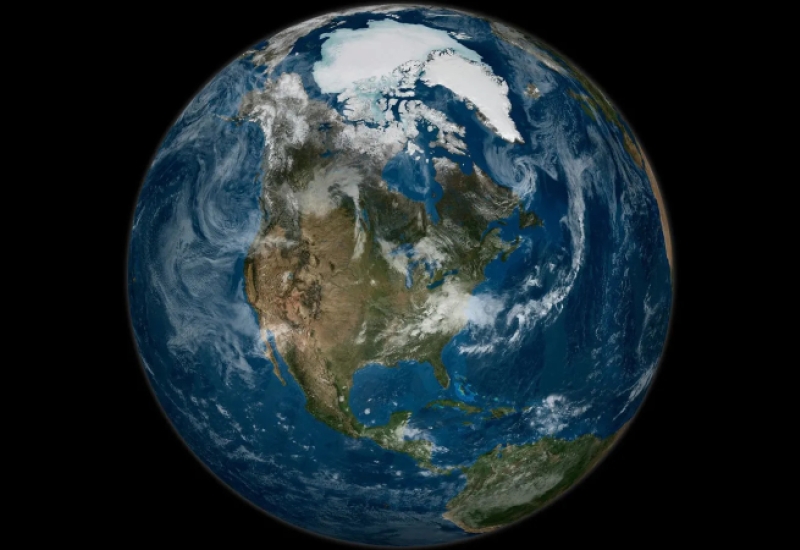
Earth spins faster when its mass is more concentrated, just as twirling figure skaters pull in their arms to speed up and spread out their arms to slow down. Rising sea levels have long been known to redistribute that mass and change the planet's spin, but the newly identified rate is unprecedented, scientists say.
Many factors influence Earth's spin speed. The moon's pull on the planet is the most significant over the long term. Its gravitational pull creates a bulge in the planet that slows Earth's rotation rate. The moon's influence increases Earth's day length by about 2.4 milliseconds per century.
However, this 2.4 millisecond rate is offset by an effect called glacial isostatic adjustment, which is the slow rise of the planet's crust that continues to occur after the retreat of the ice sheets. Glacial isostatic adjustment shortens the day length by about 0.8 millisecond per century, leading to a background lengthening over time of 1.71 milliseconds per century.
However, in recent years, the climate seems to be playing an increasing role in altering Earth's rotation. As it turned out, it is quite anomalous. The effect is therefore anthropogenic (caused by humans).
A new study turned to the fossils of shelled single-cell organisms called foraminifera to peer back millions of years into Earth's day length. Changes in the oxygen content of these fossils could reveal sea levels when the organisms were alive, from which the researchers could extrapolate day lengths.
It found that today's 1.33-millisecond-per-century increase in day length was among the fastest changes seen in the past 3.6 billion years. This is expected to get even larger and even bigger than the effect of the moon. Under a future warming scenario where greenhouse gases increase, the day could lengthen by 2.62 milliseconds per century by 2080.
Although the impact would likely not be perceptible to humans, the findings have other real-world implications. For example, instruments that require precise knowledge of Earth's rotation rate, such as those on spacecraft, may need to be recalibrated. Other precise timekeeping applications, such as in computing, could be affected.
Source: Live Science