Scientists find twisting magnetic waves on the sun
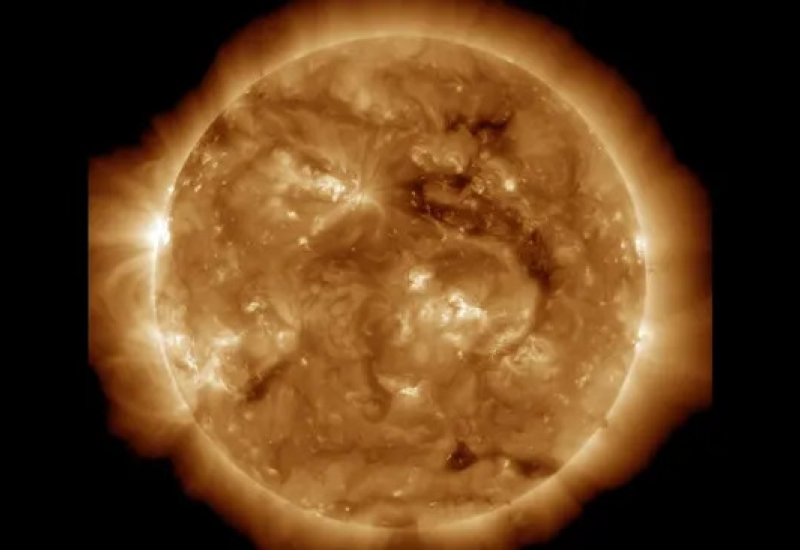
Scientists using the world's most powerful solar telescope say they've finally observed small-scale magnetic twists on the sun — a discovery that may help solve the longstanding mystery of how the sun's atmosphere grows hotter the farther it extends from the surface.
The finding, based on data from the Daniel K. Inouye Solar Telescope in Hawaii, marks the first direct evidence of tiny twisting magnetic motions of energy-packed plasma waves in the sun's outer atmosphere, or corona, known as torsional Alfvén waves.
First predicted by Swedish Nobel laureate Hannes Alfven in 1942, Alfvén waves are magnetic disturbances that travel through the plasma, the superheated, electrically charged gas that makes up the sun. Larger versions of these waves have been seen before, typically linked to solar flares, but the smaller, ever-present twisting kind had remained elusive — until now.
"This discovery ends a protracted search for these waves that has its origins in the 1940s," said Richard Morton, a professor of engineering, physics and mathematics at Northumbria University in the U.K. who led the study.
Scientists have long suspected that these small-scale waves could continuously carry energy from the sun's surface into its atmosphere, powering the solar wind and heating the corona to millions of degrees, far hotter than the sun's visible surface, which is only about 5,500 degrees Celsius.
The results offer crucial confirmation for theoretical models about how magnetic turbulence carries and dissipates energy in the sun's upper atmosphere, Morton added. "Having direct observations finally allows us to test these models against reality."
For Morton and his colleagues, the long-sought detection opens new potential investigations into how these waves propagate and dissipate energy in the corona.
Source: Nature Astronomy
Image: NASA/SDO/AIA