A Signal from the KM3NeT Underwater Telescope Can Upend Modern Physics
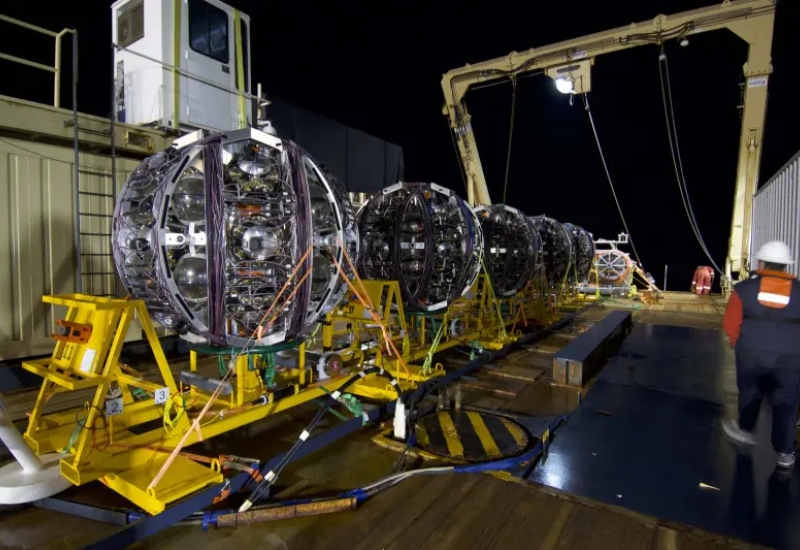
The underwater neutrino telescope KM3NeT neutrino telescope in the Mediterranean Sea has detected a neutrino with record energy—more than 100 petaelectronvolts, with one event reaching about 220 PeV. This is one of the most energetic neutrinos ever observed.
However, the observation has raised a major puzzle: why has the similar detector IceCube Neutrino Observatory in Antarctica not recorded anything comparable despite operating for a much longer period? Physicists from Oklahoma State University proposed an explanation which, if confirmed, could represent the first direct hint of new physics beyond the Standard Model.
Neutrinos are nearly massless, electrically neutral particles that interact extremely weakly with matter. They can travel through Earth, stars, and even entire galaxies almost without interaction, carrying information about the most powerful cosmic phenomena such as supernova explosions, active galactic nuclei, and gamma-ray bursts.
The detector KM3NeT neutrino telescope observed an ultra-high-energy neutrino that traveled roughly 150 km through Earth’s interior, passing through rock and seawater. During the same time, the IceCube Neutrino Observatory—located in Antarctic ice—has not detected any event with comparable energy, despite a longer observation history.
The difference in path length—about 14 km of ice versus 150 km of rock and water—appears to be crucial. The researchers suggested that the explanation may involve sterile neutrinos, hypothetical particles that barely interact with ordinary matter and are not included in the Standard Model.
Sterile neutrinos could transform into ordinary (or “active”) neutrinos while passing through matter due to the quantum phenomenon known as neutrino oscillation.
In the case of KM3NeT neutrino telescope, the longer journey through dense material may have enhanced this conversion, allowing the telescope to detect more ultra-high-energy events than the Antarctic detector.
The researchers suggest that the absence of similar events in the IceCube Neutrino Observatory may already point to new physical processes occurring at extremely high energies.
If the hypothesis is correct, sterile neutrinos—or other unknown particles—could begin playing a noticeable role at energies above 100 PeV, where the Standard Model predicts far fewer detectable events.
Source: Physical Review Letters
Image: Universidad De Granaga