Why only a small number of planets are suitable for life
For life to develop on a planet, certain chemical elements are needed in sufficient quantities. Phosphorus and nitrogen are essential. Phosphorus is vital for the formation of DNA and RNA, which store and transmit genetic information, and for the energy balance of cells. Nitrogen is an essential component of proteins, which are needed for the formation, structure and function of cells. Without these two elements, no life can develop out of lifeless matter.
A study led by Craig Walton, postdoc at the Centre for Origin and Prevalence of Life at ETH Zurich, and ETH professor Maria Schönbächler has now shown that there must be sufficient phosphorus and nitrogen present when a planet’s core is formed.
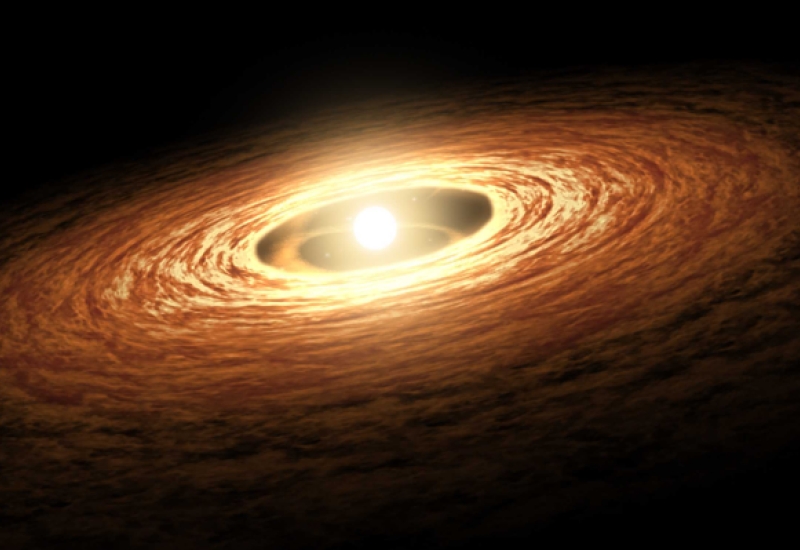
When planets form, they initially develop out of molten rock. A sorting process occurs during this time: heavy metals such as iron sink down and form the core, while lighter metals form the mantel and, later, the crust.
If there is too little oxygen present during the formation of the core, phosphorus will fuse with heavy metals such as iron and move to the core. This element is then no longer available for the development of life. On the other hand, too much oxygen present during core formation leads to phosphorus remaining in the mantle and nitrogen being more likely to escape into the atmosphere, ultimately being lost.
Walton and his co-authors demonstrated through numerous modellings that only in an exceptionally narrow range of medium-level oxygen conditions – known as a chemical Goldilocks zone – will both phosphorus and nitrogen remain in the mantle in sufficient quantities.
“Our models clearly show that the Earth is precisely within this range. If we had had just a little more or a little less oxygen during core formation, there would not have been enough phosphorus or nitrogen for the development of life,” says Walton.
The new findings could change how scientists look for life elsewhere in the universe. Until now, the focus was predominantly on whether a planet possessed water. According to Walton and Schönbächler, this falls some way short.
Source: ETH Zurich
Image: NASA-JPL