Black hole unleashes brightest flare ever – brighter than 10 trillion suns
It’s hard to wrap your head around the fundamentals of a back hole. From event horizons to singularity points and the general collapse of space-time as we understand it – the list goes on. That said, you don’t need to be an astrophysicist to grasp the enormity of the cosmic event recently recorded by researchers at Caltech’s Palomar Observatory.
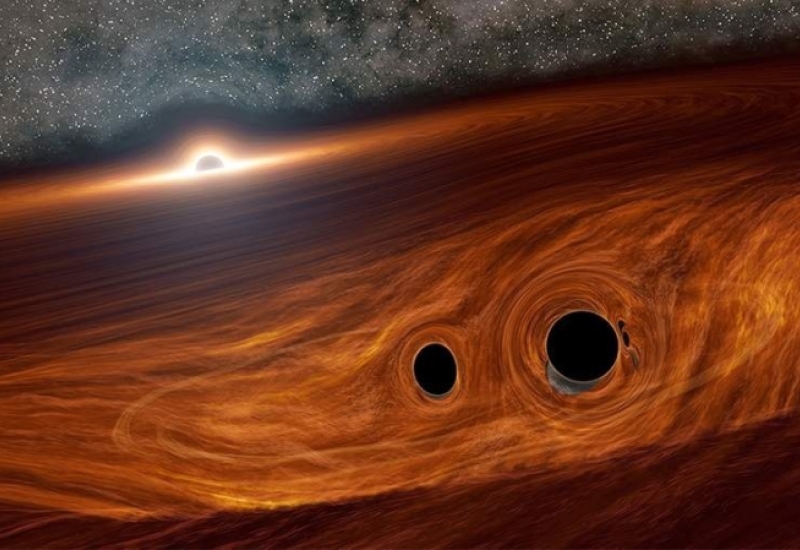
Using the Zwicky Transient Facility (ZTF) and the Catalina Real-Time Transient Survey, the team witnessed a supermassive black hole roughly 500 million times more massive than the sun make a months’ long meal out of a nearby star. At one point, the resultant black hole flare was 30 times brighter than any similar scene on record, producing 10 trillion suns’ worth of light. The activities of active galactic nucleus (AGN) J2245+3743 are detailed in a new study.
“This is unlike any AGN we’ve ever seen,” Caltech astronomy professor, ZTF project scientist, and study co-author Matthew Graham said in a statement.
Graham and colleagues first noticed increasing luminosity from J2245+3743 on April 2, 2018. However, an initial scan using Palomar Observatory’s 200-inch Hale Telescope didn’t flag anything particularly odd. But by 2023, astronomers realized that the flare was decaying slower than predicted. It was only after another spectrum scan from the W.M. Keck Observatory in Hawaii that they learned just how bright J2245+3743 had gotten. Astronomers ultimately watched as the AGN’s energy flare brightened by a factor of 40.
Graham, Ford, and their team settled on a tidal disruption event as the most likely explanation for this burst of light. Also known as a TDE, a tidal disruption event kicks off when a supermassive black hole’s gargantuan gravitational pull snags a nearby star. The black hole then begins siphoning the star’s energy as it begins its inescapable death spiral. But that doesn’t mean a star constantly shrinks after an AGN captures it. Occasionally, the energy transfer is a two-way street.
While J2245+3743 is now the record holder for brightest black hole flare ever seen, astronomers say its top spot may not be permanent. As powerful as it is, they suspect that similar events are occurring throughout the universe at any given time. Only by keeping an eye to the sky will they find any worthy competitors.
“We never would have found this rare event in the first place if it weren’t for ZTF,” said Graham. “We’ve been observing the sky with ZTF for seven years now, so when we see anything flare or change, we can see what it has done in the past and how it will evolve.”
As for J2245+3743, it still isn’t quite finished with its stellar snack. Even after two of its own years, the AGN’s flux still remains two magnitudes above its pre-flare level.
Source: Popular Science
Image: Global Look Press