The Human Mind May Be No Match for Modern Life
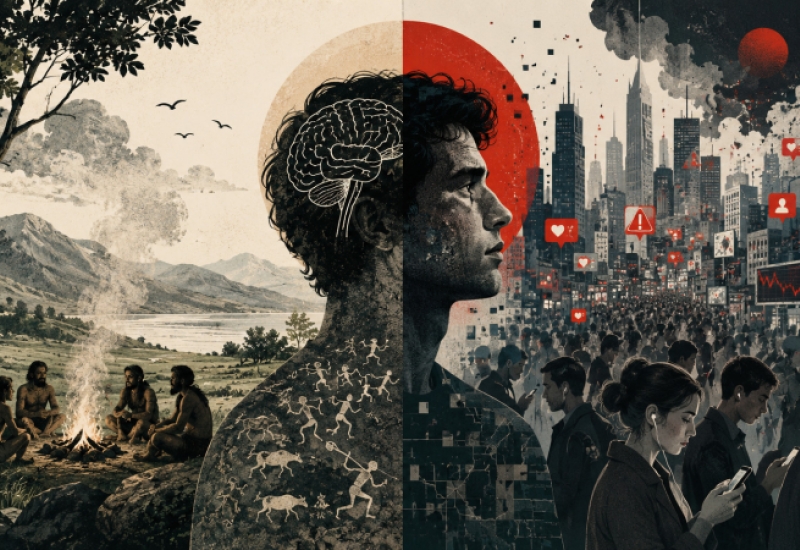
The human brain did not evolve to wake up with an alarm clock, check strangers’ achievements on social media, learn about the latest global disaster and calculate its social worth before breakfast. Every single day. Yet for many people, that is modern life.
A new scientific review argues that stress, loneliness, status anxiety, the fear of falling behind, and all the other angst typical of modern life may be partly understood as “evolutionary mismatch”: old mental systems operating in environments they were never built to handle. The authors, psychologists and sociologists in Singapore, did not perform any new experiments. Instead, they brought together research on cities, social media, inequality, health and the “polycrisis” — overlapping shocks such as climate change, conflict, economic insecurity and technological disruption.
Their central claim is simple: human beings evolved in smaller, more familiar communities, but now live amid vast populations, constant comparison, weaker local ties and a stream of threats relayed instantly through handheld devices that feel both distant and inescapable.
Evolutionary mismatch is not a new idea. It helps explain why cravings for sugar and fat, useful when calories were scarce, can backfire in a world of processed food. When you eat like your body isn’t sure when its next meal might come next, obesity is not a distant afterthought. The review extends the same logic to social life.
The scientists point out that ancestral humans likely lived in small groups, while modern people now navigate cities of strangers, social media networks, dating apps, corporate hierarchies and housing markets. We’re not alone. The vast artificial environment that we’ve built is also causing evolutionary mismatch in other species.
The authors call their key proposal the “social evolutionary mismatch and competition hypothesis.” In plain terms, many modern settings may not just stress people; they may make life feel like a nonstop contest.
“Competition is not new, but modern life can make it feel constant,” said Dr Yong in the press release. “An evolutionary perspective may help explain why people respond so strongly to comparison and the fear of falling behind, even when those signals come from strangers or screens rather than a small social group.”
Source: Science Daily
Image: ZME Science