This hidden state of water could explain why life exists
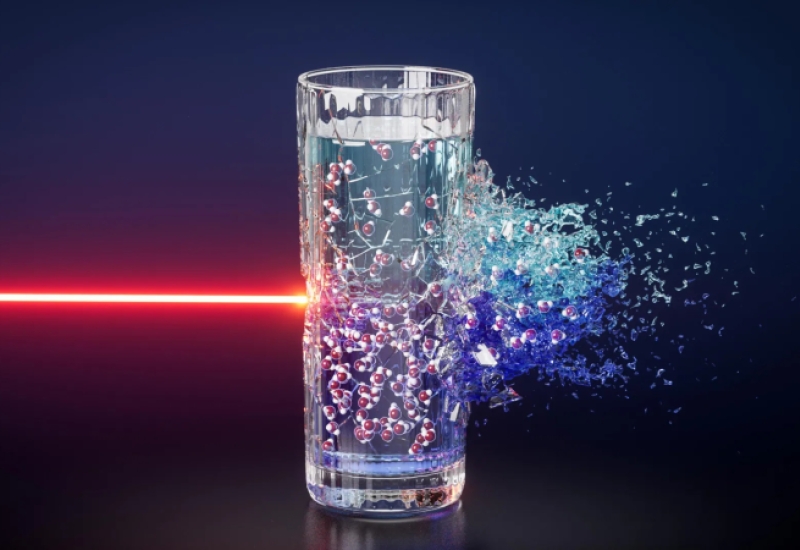
Scientists have uncovered a “hidden” state of water that may help explain why life exists on Earth.
Water is one of the most unusual liquids in the universe. Its anomalous properties—expanding below 4 °C, unusually high heat capacity, strange compressibility, and the fact that ice floats—have puzzled scientists for over a century. Now, an international team of physicists has provided the first direct experimental evidence of a special “hidden” critical state that may underlie these behaviors.
The researchers captured water in a deeply supercooled state, at about −63 °C and roughly 1,000 atmospheres of pressure. Using ultrafast X-ray pulses, they observed its structure before it could freeze.
According to study co-leader Professor Anders Nilsson, the team was able to directly observe how the boundary between two liquid phases disappears, giving rise to a new critical state.
The findings suggest that, under extreme conditions, water can exist in two distinct liquid forms that differ in their hydrogen-bond structures. At the so-called hidden critical point, these forms merge, creating a highly unstable state that is extremely sensitive to small changes.
Even under everyday conditions, water appears to retain an “echo” of this hidden state. Subtle, constant fluctuations between structural forms may explain its high heat capacity, compressibility, surface tension, and other unique properties.
Scientists have debated the origins of water’s anomalies since the time of Wilhelm Conrad Röntgen. These new results may finally help resolve that long-standing mystery.
The implications extend well beyond fundamental physics. This discovery could improve our understanding of climate processes and the natural water cycle, refine models of geological phenomena, and shed light on a key factor behind the emergence and evolution of life on Earth.
Source: Science