How fast is the universe actually expanding?
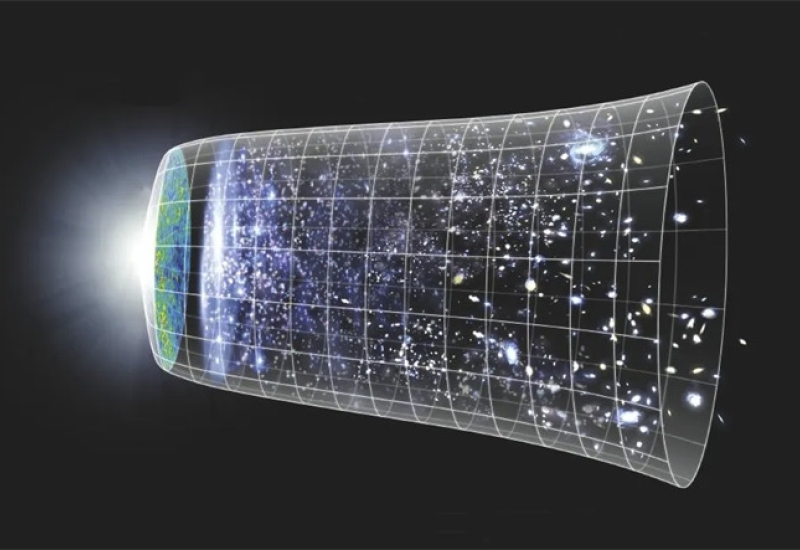
A team of scientists says it's possible to use tiny ripples in space and time, or gravitational waves, to measure the rate at which our universe is expanding. This could solve one of the biggest mysteries in physics today, a disparity in calculating this rate known as the "Hubble tension."
Scientists have known since 1998 that not only is the universe expanding, but also that the expansion rate is accelerating. “Dark energy” was introduced as a placeholder name for the mysterious force driving this acceleration, but there's an outstanding issue surrounding the universe's expansion rate in general, even after over two decades and a half of investigation.
A key part in measuring the rate of our universe's expansion is the so-called "Hubble tension" that arises from the fact that when you measure the Hubble constant starting from the local and modern-day universe — using Type 1a supernovas for your measurements — you get one value. However, when you begin the calculation starting from the distant and ancient cosmos — and use a major framework in physics called the standard model of cosmology to measure the answer— you get another value.
Scientists have therefore long been hunting for a third way to measure the Hubble constant as an extra way of checking its true value. And now, a team of researchers from the University of Illinois Urbana-Champaign and the University of Chicago thinks the answer lies with gravitational waves.
"This result is very significant — it's important to obtain an independent measurement of the Hubble constant to resolve the current Hubble tension," team leader Nicolas Yunes, the founding director of Urbana's Illinois Center for Advanced Studies of the Universe (ICASU), said in a statement. "Our method is an innovative way to enhance the accuracy of Hubble constant inferences using gravitational waves."
Gravitational waves have been proposed as a way of gauging the Hubble constant before, but the issue has been that the accuracy hasn't been there. This team thinks their novel approach has that accuracy, and says it will only increase as our gravitational wave detectors become more sensitive.
Source: University of Illinois
Image: NASA