Chinese scientists synthesize meteorite diamond harder than Earth diamond
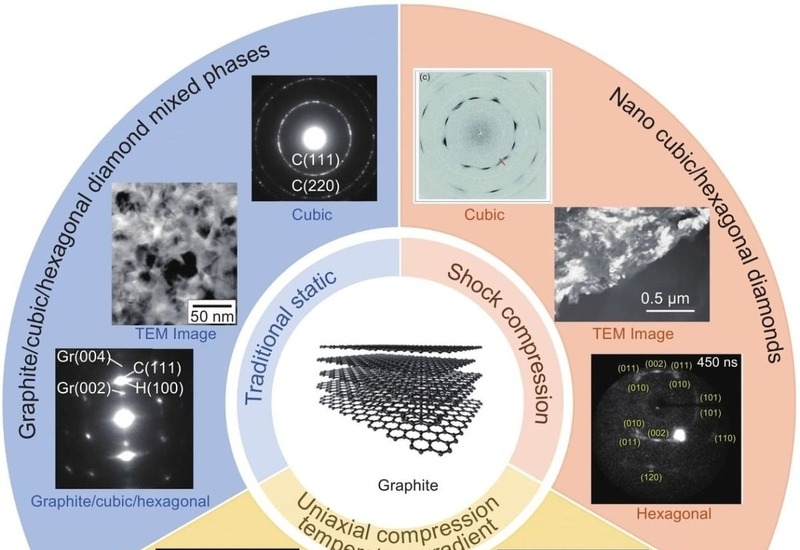
Chinese researchers have succeeded in synthesizing the hundred-micron-scale hexagonal diamond, a material primarily found in meteorites, which is harder than the ordinary diamond found on Earth.
The Earth diamond owes its reputation as the king of hardness to its carbon atoms arranged in a tetrahedral lattice, making it extremely hard and wear-resistant.
However, this structure has a weakness – certain planes can easily slip and shift when force is applied, thereby limiting its strength. As a consequence, scientists have turned their attention to another type of super diamond with a more exquisite structure and superior properties, namely the hexagonal diamond.
Chinese researchers involved in the study innovatively proposed a method for transforming graphite into a hexagonal diamond. Under controllable high-temperature, high-pressure and quasi-hydrostatic conditions, they compressed and heated graphite single crystals to ultimately obtain a high-purity hexagonal diamond.
Previous attempts to synthesize a hexagonal diamond were largely unsuccessful due to extremely stringent formation requirements. Under high-temperature and high-pressure conditions, the end result tends to be the formation of a cubic diamond and not a hexagonal diamond.
This study lays a methodological foundation for future research on diamond-like materials. This synthesized hexagonal diamond is expected to pave new pathways for the development of superhard materials and high-end electronic devices.
Source: Nature
Image: De-si CHEN et al