Robots have learned to repair themselves
Modern robots have long been closed, rigid systems, incapable of self-shaping, growth, or repair. Their bodies still depend on humans: if a part breaks, engineers must intervene; if an upgrade is needed, it’s all down to the workshop. But a team of scientists at Columbia University has changed that thinking by developing the concept of “robot metabolism” — an approach in which machines can do more than just function, but physically evolve, heal, and modify themselves, using available resources from the environment or from other robots.
The new system is inspired by biological principles. In living organisms, modular structure allows the same components — amino acids, cells — to be used and recycled for repair, growth, and adaptation. According to Columbia University professor Hod Lipson, it is this modularity and self-service ability that has allowed living beings to become so flexible. If this principle is transferred to robotics, machines will be able not only to make decisions, but also to maintain their physical viability — similar to metabolism in living systems.
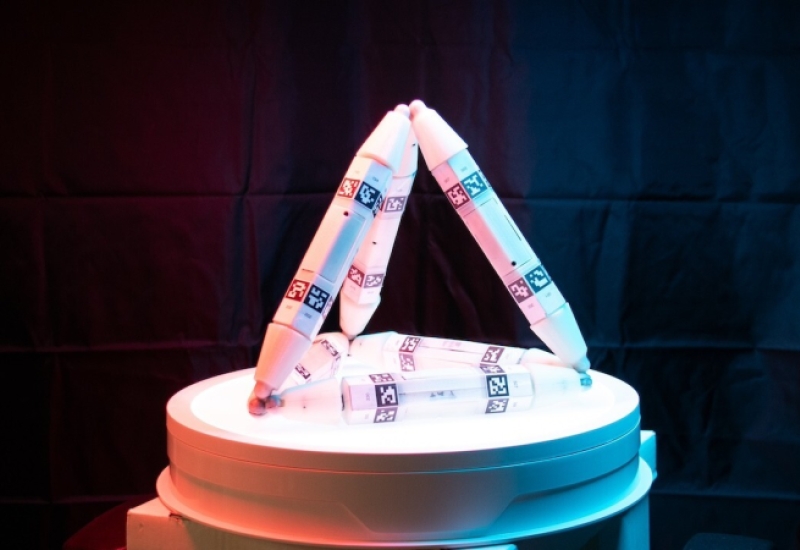
The central element of the development was the Truss Link system — a magnetic module that looks like a Geomag toy. These compact links can be connected to each other at different angles, forming complex structures. Due to their simplicity and versatility, they allow for the assembly of two-dimensional forms that are later transformed into three-dimensional robots. The operating principle was confirmed in practice: one of the tetrahedral robots created “grew” an additional element in the form of a support, thereby increasing the speed of movement along an inclined surface by 66.5%.
According to the study, metabolic robots will be able to collect or select suitable modules – both from their own environment and from other machines. This creates the conditions for the emergence of self-sustaining systems that do not depend on constant maintenance.
Source: Science Advances
Image: Columbia Engineering